ROI of Trade Show Entertainment: Maximising Lead Gen in Dubai 2026
Calculate the ROI of trade show entertainment with our data-driven guide. Turn your Dubai 2026 booth into a lead gen engine using proven formulas and tech ma...
With companies reporting an average return of $20.98 for every $1 spent on exhibitions, why does your booth still feel like an expensive ghost town? Calculating the ROI of trade show entertainment is often the missing piece in that equation. You've likely felt the frustration of watching high-value "aisle-walkers" drift past your stand at the Dubai World Trade Centre while your sales team waits for an opening that never comes. It's difficult to justify the cost of a premium activation when you can't clearly track how a performer translates into a qualified sales pipeline.
We agree that entertainment should never be a hollow spectacle. It's a strategic filter designed to capture attention and qualify prospects in seconds. This guide promises to give you a data-driven framework to turn booth entertainment into a high-performance lead generation engine. We'll explore a clear formula to calculate your returns, techniques to increase dwell time using tech-forward iPad magic, and a proven strategy for generating a higher volume of marketing qualified leads (MQLs) at your next event in 2026.
Key Takeaways
- Learn how to define the ROI of trade show entertainment by moving beyond passive attendance and focusing on a data-driven ratio of leads to activation costs.
- Understand the psychology of the "3-second rule" and how specialized iPad magic acts as a pattern interrupt to capture the attention of busy decision-makers.
- Master the use of quantitative KPIs, including badge scan percentages and dwell time, to measure the concrete success of your booth's engagement strategy.
- Gain a clear, step-by-step formula to calculate your final returns by tracking lead volume specifically during active performance windows at the DWTC.
- Discover how to integrate your core brand messaging into the performance through bespoke scripting, ensuring every illusion reinforces your specific product benefits.
Defining the ROI of Trade Show Entertainment in 2026
In the high-stakes environment of the Dubai World Trade Centre (DWTC), calculating the ROI of trade show entertainment isn't just a financial exercise; it's a survival strategy. In 2026, the simple ratio of net profit or leads generated against the cost of your activation determines whether your exhibition was a success or a sunk cost. Many brands fall into the trap of building passive monuments to their logo, hoping that a sleek design will naturally draw people in. However, in a hall filled with world-class architecture, "passive" is often another word for "invisible."
The difference lies in distinguishing vanity metrics from value metrics. A large crowd gathered around a booth looks impressive in a post-event report, but if those individuals aren't your target demographic, they're just floor traffic. True value metrics focus on qualified leads and the eventual impact on the sales pipeline. Professional entertainment acts as a force multiplier for your sales team, breaking the ice with "aisle-walkers" and handing off warm, engaged prospects to your experts. It transforms a cold encounter into a memorable brand experience.
The Shift from Passive to Active Engagement
High-end stand builds are the baseline in Dubai, not the differentiator. To stand out at events like Gitex Global, brands are moving toward the concept of the "Booth Infotainer." This role combines brand messaging with high-impact engagement, such as iPad magic, to demonstrate tech products in a way that sticks. We define Trade Show ROI as the delta between cost-per-lead with and without professional engagement. By using active engagement, you're not just buying a performer; you're buying a lead-qualification filter that prevents your sales team from wasting time on unqualified visitors.
Hard ROI vs. Soft ROI in Corporate Entertainment
When evaluating your ROI of trade show entertainment, you must look at both hard and soft data points. Hard ROI includes measurable outcomes like lead volume, cost per lead (CPL), and the total value of the sales pipeline generated during the event. These are the numbers that satisfy the C-suite. Soft ROI, while harder to quantify, is equally vital for modern event marketing strategies. This includes brand sentiment, social media mentions, and word-of-mouth buzz. Dubai brands often prioritize high-impact visual storytelling because it creates a lasting impression that transcends the physical booth, ensuring your brand is the one attendees remember long after the service gates at the DWTC have closed.
The Psychology of 'Stopping Power': How Magic Converts Traffic
Walking through a hall at the DWTC, attendees naturally develop "booth blindness." They've seen dozens of LED screens and heard a hundred generic pitches before they even reach your aisle. To maximize the ROI of trade show entertainment, you have to master the 3-second rule. This is the tiny window of time you have to capture a visitor's attention before they walk past your stand. Professional trade show magic acts as a powerful "pattern interrupt." When someone sees a digital object pulled out of an iPad screen, their brain stops its autopilot routine and focuses entirely on your space.
This engagement creates what psychologists call an "Open Loop." The trick creates a moment of curiosity that the brain feels compelled to resolve. By the time the viewer is wondering how the illusion worked, their defensive barriers are down. This is the perfect moment to transition from a "magic trick" to a "brand message." If you want to see how these interactions look in real-time, you can explore recent brand activations on Instagram. Moving from a spectacle to a business conversation requires a performer who understands how to bridge the gap without losing the audience's interest.
Breaking the Aisle Barrier
Visitors build mental walls against aggressive sales pitches. They don't want to be "sold to" the moment they step onto your carpet. Close-up magic and mentalism lower these defenses by offering immediate value and entertainment. Thomas McElroy uses digital illusions to integrate product USPs directly into the performance. Instead of a dry list of features, the audience sees those benefits manifested through sleight of hand, making the information feel earned rather than forced. This builds instant rapport, turning a skeptical "aisle-walker" into an engaged prospect.
Lead Qualification at Scale
A professional entertainer isn't just there to perform; they're there to filter. While the crowd watches, the performer identifies high-value prospects based on their reactions, titles, and engagement levels. This allows for a seamless "hand-off" where the visitor is transitioned to a sales representative while they're still in a state of high engagement. By using iPad magic, a performer can physically demonstrate complex software features in a memorable way that stays with the prospect long after they leave the booth. This strategic approach ensures that the ROI of trade show entertainment is measured by the quality of the conversations started, not just the volume of people standing in the aisle.
Measuring Success: Quantitative vs. Qualitative Trade Show KPIs
Success at a Dubai exhibition is often measured by the energy at the booth, but energy doesn't pay the bills. To truly understand the ROI of trade show entertainment, you need to track specific Key Performance Indicators (KPIs) that bridge the gap between a "good show" and a "profitable show." Your primary quantitative metric should be the percentage increase in badge scans compared to previous years. If your entertainer effectively filters the crowd, you'll see a spike in high-quality data capture without the usual "swipe-and-run" fatigue that plagues passive stands.
Secondary metrics like dwell time provide deeper insight into engagement. When visitors stay at your stand for five minutes instead of thirty seconds, your sales team has a significantly higher chance of uncovering pain points and building trust. We also track the lead-to-meeting conversion rate post-event. A lead generated through a memorable interaction, such as a mentalism demonstration, often has a higher recall rate. This makes them far more likely to accept a follow-up call than someone who just grabbed a branded pen while walking past.
Qualitative success is equally vital, even if it's harder to plot on a graph. The "water cooler effect" refers to attendees discussing your brand across the exhibition floor or back at their offices in the days following the show. This level of brand recall is what turns a one-time visitor into a long-term client, ensuring your company remains top-of-mind when procurement decisions are made.
Data Capture and CRM Integration
Professional entertainment provides a natural reason for visitors to share their information. Instead of an awkward request for a business card, the performer can use magic to incentivise badge scanning as part of the experience. By tagging these leads in your CRM as "Entertainment Activation," you can directly attribute sales pipeline growth to your specific booth activities. It's about creating a traceable path from the first "wow" moment to the final contract. For a deeper look at how this works in practice, check out our guide on Trade Show Magic Dubai: Standing Out at the DWTC.
Social Media Amplification
In 2026, your booth's reach shouldn't be limited to the physical floor of the DWTC. Creating "Instagrammable" moments through iPad magic allows your brand to travel far beyond the hall. When attendees film a digital illusion and post it using your event hashtags, they're providing free third-party validation to their entire professional network. Viral magic clips featuring your brand logo act as digital breadcrumbs, leading a global audience back to your services and extending the ROI of trade show entertainment long after the event concludes.
How to Calculate Your Trade Show Entertainment ROI
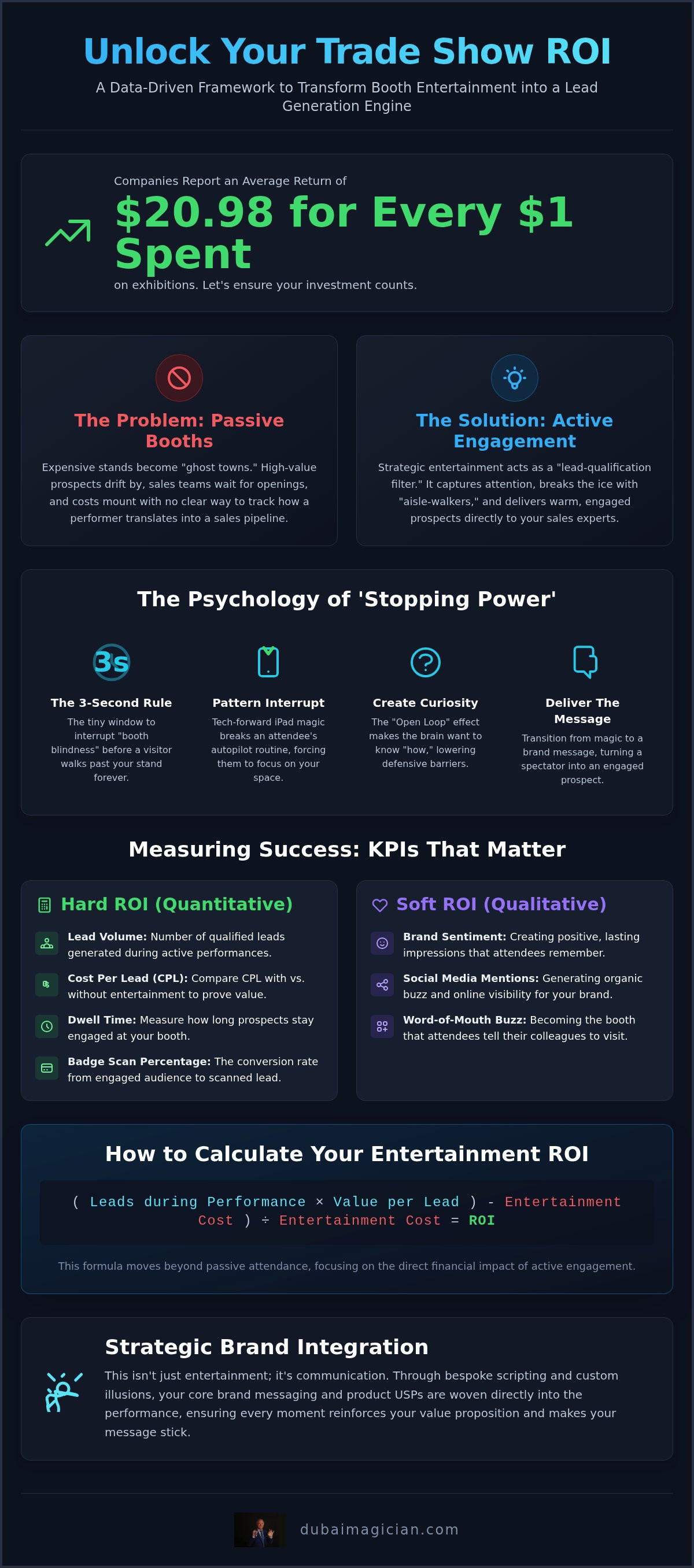
Moving from anecdotal success to concrete financial data requires a structured approach to your math. To accurately determine the ROI of trade show entertainment, you must track the specific performance of your booth during active engagement windows. This isn't about guessing how many people looked at your logo; it's about identifying the financial delta between a passive stand and an active, entertainment-driven lead engine. Follow these four steps to build your calculation.
- Step 1: Determine the total cost of the activation. This includes the booking fee, any custom digital branding for iPad magic performances, and travel or accommodation expenses.
- Step 2: Track the total number of leads generated specifically during the hours the entertainer is active on the floor.
- Step 3: Calculate the Cost Per Lead (CPL) by dividing the activation cost by the number of leads. Compare this figure to the CPL during "passive" hours where no entertainment was present.
- Step 4: Factor in the estimated Lifetime Value (LTV) of a qualified lead. If your average contract value is high, even a small increase in qualified hand-offs represents a massive return.
The ROI Formula for Booth Engagement
The core equation for success is relatively simple: (Total Value of Leads - Total Cost of Entertainment) / Total Cost of Entertainment. However, the nuance lies in how you weigh "Cold Leads" versus "Hot Leads." A lead who has spent five minutes engaging with a mentalism performance and a sales rep is significantly more valuable than a name on a list. We recommend booth managers use a control group by tracking leads during hours without entertainment to find the exact uplift percentage attributed to the performer. This data allows you to prove that the entertainer isn't just an expense; they're a lead-generation tool that lowers your overall CPL. To see how these lead-generation techniques look in practice, you can view live performance clips on Instagram.
Long-term Pipeline Impact
True ROI doesn't end when the DWTC or ADNEC exhibition hall closes. You should track lead conversion rates at the 6 month and 12 month marks to see how many "entertainment-sourced" leads turned into signed contracts. There's also a "Halo Effect" to consider. Existing clients who visit your booth and experience a high-end iPad magic demonstration often leave with a renewed sense of brand loyalty. This strengthened relationship is a vital qualitative return that prevents churn and encourages referrals. For a broader look at how these elements fit into your total event strategy, see our guide on Corporate Magician Dubai: Modern Business Entertainment.
Strategic Brand Integration: The Thomas McElroy Approach
Generic magic often fails at exhibitions because it lacks a clear business purpose. While a card trick might draw a crowd, it rarely converts that crowd into a sales pipeline if the performer doesn't understand your unique selling propositions. To truly maximize the ROI of trade show entertainment, the performance must be an extension of your brand’s voice. Thomas McElroy positions himself as a lead generator who happens to use magic, ensuring every illusion serves to highlight a product feature or corporate message rather than just providing a momentary distraction.
This approach relies heavily on bespoke scripting and the customization of digital assets. For tech-forward brands, iPad magic offers a unique opportunity to put your product literally inside the magician’s hands. At a recent Gitex Global event, a tech firm integrated their latest software interface into a series of digital illusions. By pulling virtual components out of the iPad screen and into the physical world, they achieved record-breaking badge scans that far exceeded their previous passive booth benchmarks. This level of integration ensures that the "wow" moment is inseparable from the brand itself.
Beyond the Trick: Messaging and Tone
When working with prestigious names like Louis Vuitton or Mercedes-Benz, the entertainment can't just be clever; it has to be sophisticated. Thomas ensures his attire, vocabulary, and performance style align perfectly with high-end corporate values. His process involves learning a client’s core product benefits well before the event begins. This allows him to qualify leads by asking the right questions during a performance. He doesn't just show a trick; he starts a conversation that makes the eventual hand-off to your sales team feel like a natural progression of the experience.
Next Steps for Your 2026 Exhibition Strategy
Exhibition seasons in Dubai, particularly Q1 and Q4, are incredibly competitive. To secure a specialist who understands the nuances of the DWTC and can deliver a measurable ROI of trade show entertainment, you should start the briefing process early. Providing your entertainer with a clear list of goals, target job titles, and key brand pillars allows them to build a performance that acts as a precision tool for your sales team. If you're ready to transform your booth from a passive display into an active lead-generation engine, you can Consult with Thomas McElroy on your 2026 Trade Show strategy. Booking timelines for peak seasons fill up quickly, so early alignment is essential for success.
Elevate Your 2026 Exhibition Performance
Transforming your booth from a static display into a high-conversion lead engine requires more than just premium architecture. By focusing on the ROI of trade show entertainment, you move beyond vanity metrics and start capturing data that directly impacts your sales pipeline. We've explored how a strategic blend of psychology, tech-forward iPad magic, and bespoke brand integration can filter the crowd at the DWTC and hand off qualified prospects to your team.
As a Dubai-based expert with over 10 years of experience at the DWTC, Thomas McElroy has delivered these results for global brands like Dior, Louis Vuitton, and Mercedes-Benz. He specializes in high-conversion iPad magic that turns casual visitors into marketing qualified leads. It's time to stop letting "aisle-walkers" pass you by and start turning every interaction into a measurable business outcome. You can see these high-impact activations in action when you book Thomas McElroy for your next high-ROI trade show activation. Your brand deserves to be the most talked-about stand in the hall.
Frequently Asked Questions
Is trade show entertainment worth the investment for B2B brands?
Professional entertainment is a strategic investment that lowers your cost-per-lead by increasing booth throughput. In a competitive market like Dubai, it acts as a pattern interrupt that stops decision-makers who would otherwise walk past your stand. By engaging visitors immediately, you maximize the ROI of trade show entertainment through higher volumes of qualified hand-offs to your sales team, ensuring your expensive floor space at the DWTC isn't wasted on passive displays.
How does a trade show magician actually generate leads?
A trade show magician acts as a front-of-house lead qualifier. They use illusions to draw a crowd and then filter that audience based on job titles or pain points during the performance. By creating a high-energy environment, they make it easy for your sales reps to step in and scan badges. This process turns cold aisle-walkers into warm prospects who are already engaged and ready to discuss your business solutions in depth.
Can magic be customised to show my specific product or logo?
Customization is the core of effective brand integration. Thomas McElroy specializes in iPad magic, where your company logo, specific product images, or software interface can be programmed directly into the digital illusions. This allows the performer to pull your physical product out of a screen or make your brand message the reveal of a mentalism trick. This level of bespoke scripting ensures that every wow moment is tied directly to your corporate identity.
What is the best way to measure ROI for a booth performer?
The most accurate way to measure the ROI of trade show entertainment is to track badge scan increases during active performance hours versus passive hours. You should also monitor lead-to-meeting conversion rates post-event. Leads generated through a memorable, interactive experience have higher recall, making them more likely to accept a follow-up call. Tracking these metrics in your CRM allows you to see the direct financial impact on your sales pipeline.
Does hiring an entertainer distract people from our sales pitch?
Professional trade show magic does the opposite of distracting; it acts as a force multiplier for your sales team. The performer's job is to break the ice and handle the initial social friction of starting a conversation. Once the audience is engaged and the performer has qualified their interest, they seamlessly hand the prospect over to a sales representative. This ensures your team spends their time talking to interested leads rather than trying to flag down passersby.
What types of magic work best for high-tech trade shows in Dubai?
For tech-forward exhibitions like Gitex Global, iPad magic and digital mentalism are exceptionally effective. These formats align with the innovative environment of Dubai's high-tech shows. Using tablets to perform illusions feels modern and professional, allowing for the seamless integration of software demos and digital brand assets. It demonstrates that your company is forward-thinking and uses cutting-edge technology not just in your products, but in how you engage with your audience.
How early should I book a trade show magician for events at the DWTC?
You should book your entertainer at least three to six months in advance, especially for peak seasons in Dubai. The exhibition calendar at the DWTC is busiest during the first and fourth quarters of the year. High-demand specialists who understand brand integration and lead generation often have their schedules filled months before the event starts. Early booking provides more time for custom scripting and digital asset development to ensure the performance matches your goals.
Can entertainment help with badge scanning and data collection?
Entertainment provides a natural incentive for visitors to participate in data collection. Instead of a cold request for a scan, the performer can incorporate the badge scan into the magic trick itself. This makes the data capture feel like a part of the experience rather than a hurdle. It results in a much higher volume of scans and ensures your CRM is populated with leads who have already had a positive, memorable interaction with your brand.